
The Math of Burnout: Why Your $700 Trip might be Losing Money

There is a dangerous habit in the charter industry called "Pricing by Proximity."
It works like this: You buy a boat. You get your license. You walk down the dock and ask, "What is Captain Steve charging?" Steve says $700. So, you print your brochures and list your price at $700.
You just made a fatal business error. You are letting a stranger—who might be going broke himself—dictate your salary.
Captains are great at reading currents, but many are terrible at reading P&L statements. The reality is that a full calendar does not equal a profitable business. We see captains every season who run 100 trips and still can't afford to replace their lower unit when it blows.
Here is the "Burnout Math" that destroys charter businesses, and how to fix it.
The Illusion of Cash Flow
When a client hands you $700 cash at the dock, it feels like a win. You do a quick mental calculation:
$150 for fuel.
$50 for ice and bait.
$100 for the mate.
Result: "I just made $400 for a morning of fishing!"
That is Cash Flow. It is not Profit. That $400 has to pay for things you aren't thinking about while you are filleting fish.
The Invisible Anchors
To find your "True Cost Per Trip," you have to factor in the expenses that happen even when the boat never leaves the slip.
Depreciation: Every hour you put on those outboards brings them one hour closer to death. If a repower costs $40,000 and the engines last 2,000 hours, that is $20 per hour in direct depreciation. A 6-hour trip just cost you $120 in engine life.
Fixed Costs: Insurance, slip fees, permit renewals, and the boat loan.
If you divide your annual fixed costs by the number of trips you hope to run, you’ll find that just "unlocking the boat" costs you $200 before you even turn the key.
The "Perishable Inventory" Factor
This is the variable that kills the copycat pricing model. Unlike a t-shirt shop, your inventory expires instantly. If you have a boat available on Tuesday and it rains, you cannot sell two Tuesdays next week. That revenue is gone forever.
If you price your trips assuming 100% fishable days, you will fail. Your $700 trip on Saturday doesn't just have to pay for Saturday; it has to subsidize the rainy Tuesday and the windy Wednesday. If your pricing doesn't include a "Vacancy Risk Premium," you are effectively fishing for free on the good days to pay for the bad days.
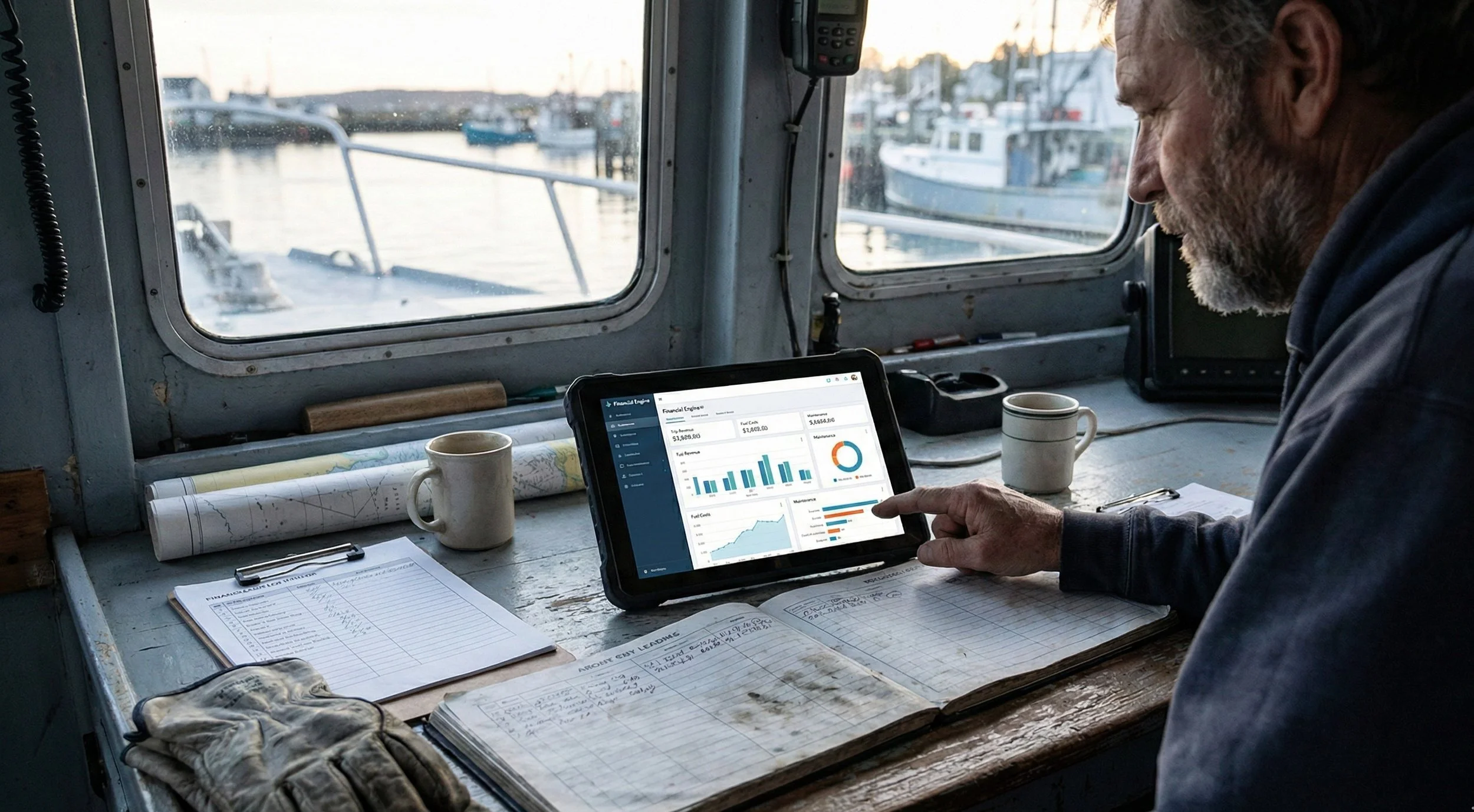
The Minimum Wage Captain
Let’s redo the math with a "Financial Engineering" mindset:
Gross Revenue: $700
COGS (Fuel/Bait/Mate): -$300
Fixed Cost Allocation: -$150
Engine Reserve (Depreciation): -$100
True Net Profit: $150
Now, consider the time investment. You woke up at 4:00 AM. You prepped the boat. You ran the trip. You cleaned the fish. You scrubbed the deck. You finished at 2:00 PM. 10 Hours of labor for $150.
Congratulations, Captain. You are making $15/hour—less than the kid working the fryer at the fast-food joint down the street. And he doesn't have a million dollars of liability hanging over his head.
Stop Guessing. Start Engineering.
You cannot run a business on "Captain Steve's" math. You need to price for your boat, your overhead, and your financial goals.
If the math says you need to charge $850 to make a living wage, then you charge $850. If you are afraid clients won't pay it, that is a marketing problem, not a pricing problem. But lowering your price to match the competition is a suicide pact.
Revenue feeds the boat. Profit feeds your family. Do not confuse the two.
About Captains Business Academy
We don't teach you how to catch fish; you already know how to do that. We teach you the business systems, financial engineering, and legal structures required to turn a fishing habit into a profitable enterprise. View the Course Curriculum
Ready to Stop Guessing?
Most captains run their business by "feeling." We run ours by the numbers. If you are ready to install a professional operating system for your charter business, join the Academy today. You'll get instant access to the Financial Engine Calculator, the marketing templates, and the compliance checklists. Enroll in the Academy
The information provided in "From the Helm" is for educational purposes only and does not constitute legal, tax, or financial advice. We are experienced captains and business owners, not attorneys or CPAs. Always consult with a qualified professional regarding your specific business situation.