
How to Run a Successful Charter Business: From Deckhand Technician to CEO

The Hard Truth: The 100-Hour Work Week
You started this business because you love being on the water. You love the hunt, the rigging, reading the currents, and the moment the drag screams. You are an excellent fisherman, a skilled boat handler, and you know how to show clients a good time. You are a master technician.
But here is the painful reality that most captains discover around Year Three: Being a great technician on the back deck has almost nothing to do with running a successful charter business.
Look at your current schedule. If you are waking up at 3:00 AM to ice the cooler, running the trip, cleaning the fish, scrubbing the boat until 7:00 PM, and then falling asleep at the kitchen table trying to answer booking emails on your phone—you don't own a business. You just bought yourself the lowest-paying, highest-stress job on the dock.
The Technician Trap
In the business world, there is a concept known as the "E-Myth" (Entrepreneurial Myth). It states that most businesses aren't started by entrepreneurs; they are started by technicians suffering from an "entrepreneurial seizure."
They believe that because they understand the technical work of a business, they inherently understand how to run a business that does that technical work.
In the maritime industry, this is fatal. Captains believe that because they know how to catch fish, they automatically know how to engineer unit economics, manage perishable inventory, and navigate Coast Guard compliance. As long as you view your primary value as "the guy who ties the knots and drives the boat," you will hit a financial ceiling. You will burn out, your income will plateau, and your operation will be entirely dependent on your physical presence every single day.
The Shift to the Helm
To move from a struggling operator to a profitable business owner, you must mentally shift from the back deck to the wheelhouse. You need to stop acting like a high-paid deckhand and start acting like a CEO.
A CEO doesn't measure their day by how many fish they boxed. They measure their day by the systems they built, the margins they protected, and the liabilities they mitigated.
Here is exactly what the shift from Technician to CEO looks like in a modern charter operation:
1. Building Standard Operating Procedures (SOPs)
The Technician scrubs the deck for an hour after every trip, doing it from memory, and gets frustrated when a mate misses a spot.
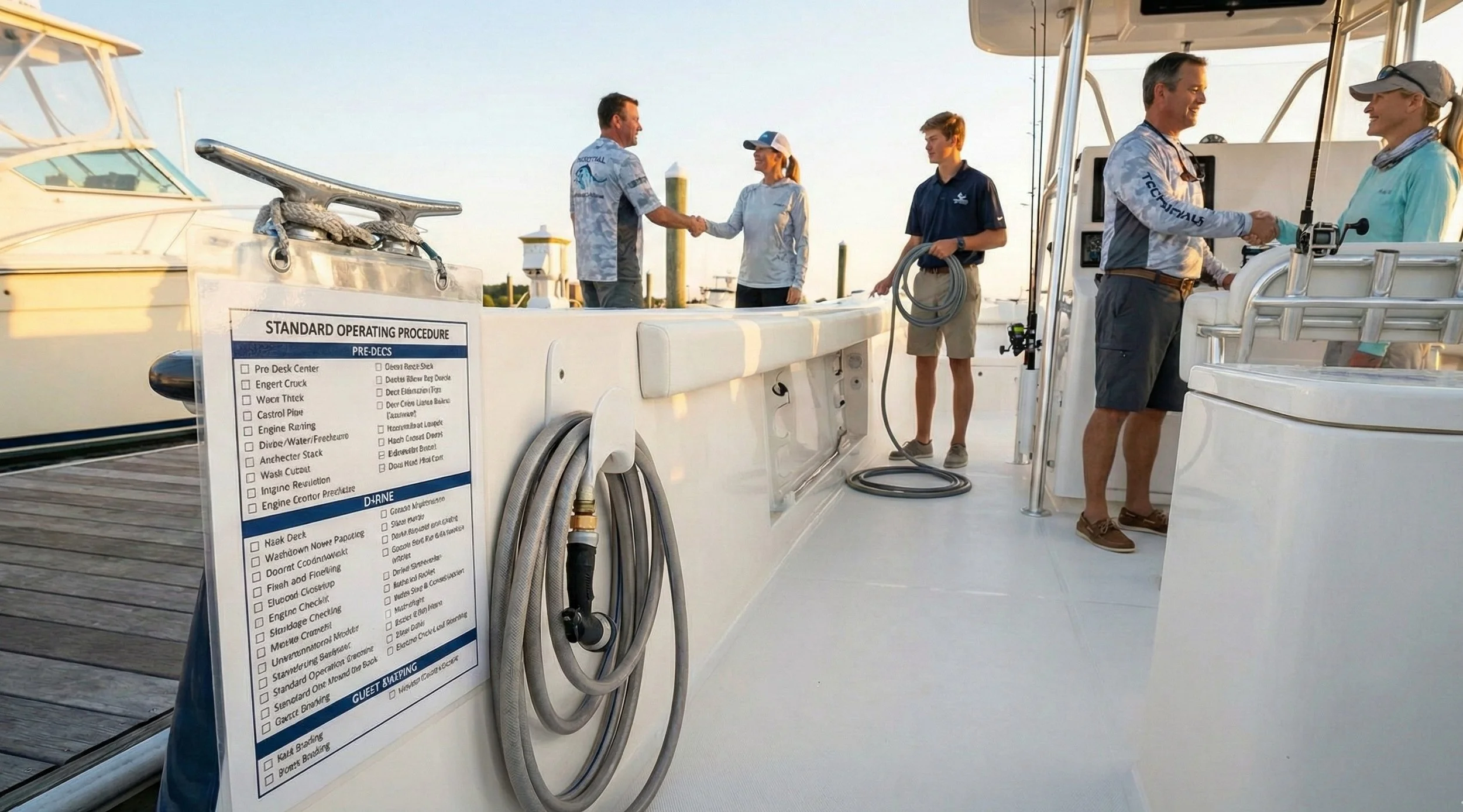
The CEO writes a 15-point "Post-Trip Washdown & Shutdown SOP." They laminate it, hang it near the raw water washdown, and hire a professional mate to execute it flawlessly every single time. The CEO reclaims that hour to focus on revenue-generating tasks.
2. Automating the "Digital Dock"
The Technician hopes the phone rings, relies on walk-up marina traffic, and spends hours playing phone tag with tire-kickers asking for discounts.
The CEO builds a "Digital Dock." They install an automated booking calendar on their website, enforce a strict 72-hour cancellation policy with upfront deposits, and utilize an automated email sequence that sends clients their pre-trip briefing while the captain sleeps.
3. Owning the Data (Not Just the Secret Spots)
The Technician holds the GPS coordinates of the secret wreck in their head and gauges the success of the season by the feeling in their gut.
The CEO documents the numbers. They know their exact "True Cost Per Trip." They use their chartplotter tracks to prove legal compliance. They run a P&L (Profit and Loss) statement every month so the business relies on hard data, not intuition.
The "Hourly Rate" Wake-Up Call
To force this mental shift, you must calculate what your time is actually worth.
Every hour you spend doing $20/hour work (washing the boat, changing the oil, responding to basic Instagram DMs) is an hour you are not doing $200/hour work.
What does $200/hour work look like for a charter captain? It looks like auditing your commercial insurance policy to ensure you aren't overpaying. It looks like analyzing your P&L to implement dynamic pricing for peak holiday weekends. It looks like building strategic partnerships with local high-end hotels to secure a pipeline of premium clients.
You cannot scale "you." You can only scale systems.
Building a Sellable Asset
This is the ultimate endgame. If your entire business model relies on your specific personality, your physical labor, and your secret knowledge, you cannot sell your business when you are ready to retire. When you stop working, the business evaporates.
But if you build systems, standard operating procedures, a brand independent of your name, and a documented financial history, you are no longer just a captain. You are the owner of a transferable, sellable asset.
The sooner you fire yourself from the deckhand duties and hire yourself as the executive, the sooner you will build a business that serves you, rather than you serving the business.
About Captains Business Academy
We don't teach you how to catch fish; you already know how to do that. We teach you the business systems, financial engineering, and legal structures required to turn a fishing habit into a profitable enterprise. View the Course Curriculum
Ready to Stop Guessing?
Most captains run their business by "feeling." We run ours by the numbers. If you are ready to install a professional operating system for your charter business, join the Academy today. You'll get instant access to the Financial Engine Calculator, the marketing templates, and the compliance checklists. Enroll in the Academy
The information provided in "From the Helm" is for educational purposes only and does not constitute legal, tax, or financial advice. We are experienced captains and business owners, not attorneys or CPAs. Always consult with a qualified professional regarding your specific business situation.